Author: Elsie Danjuma
Stay safe! Stay home! Save lives! These phrases cannot be overemphasized.
Do you realize it is when you are told to do something right that all your
creative juices feel like rebelling? Most people are finding it hard to
understand how just staying at home, can prevent me, you and the whole
world from contracting a mere virus?
Why is it that the simplest instructions are the hardest to abide by? We have
been told that staying home and stopping all non-essential travels can help
mitigate the spread of the virus. Please let's all stay at home to flatten the
curve. It is said that “the virus doesn't move, we move it”. We stop moving, the
virus stops moving, the virus dies. It is that simple. This is not the time to go
‘gyming’ with our colleagues and estate buddies, it is not the time to host big
parties and ceremonies, and it is certainly not the time to congregate in large
numbers.
The curve researchers are talking about, refers to the projected number of
people who will contract Covid-19 over a period of time. To flatten the curve
means to reduce the incidence of infection over a given time.
How best can this curve be flattened when dealing with countries with
underutilized resources, lack of data base, malnutrition, hospitals with
inadequate facilities, manpower and testing? If highly developed countries
are already overwhelmed, how much more developing countries. Drastic
measures need to be put in place, and stringent methods adopted, especially
in Africa, before any lockdown is lifted, so we don't end up with a repeat of
the Spanish flu which infected over 500 million people and claimed over 50
million lives between 1918 and 1920.
Hospitals are said to be a war zone for now and should be avoided as much
as possible. Charles Bergquistic director of the public radio science show
tweeted "Your work place bathroom has only so many stalls. If everyone
decides to go the same time, there are problems. If the same number of people
need to go to the restroom but spread over several hours, it is okay". This is in
an ideal situation, think of it in this scenario, you go to the bathrooms and
there is no water to flush with so many people in line. Your guess is as good
as mine.
Let us stay safe and stay healthy, so we don’t overrun our hospitals. Melinda
Gates said "the more we do to keep ourselves and our neighbours healthy, the
better positioned we will all be to weather this challenge”.
Even as nations begin to gradually ease lockdown measures and gradually
reopen their economies in phases, we must take responsibility to ensure that
there is no major relapse that could lead to a more devastating second wave.
We can beat this together and all come out alive. Therefore, we must do well
to stay home as much as possible if we have no business being out.
Stay Alert! Stay Safe! Stay Alive!
Wednesday, 20 May 2020

Wednesday, 6 May 2020
This Love Thing
 |
| This WhatsApp status prompted me to share this story. |
Bee had a clique of really beautiful friends. 'Classy girls' and you'd be right. For some reason, I couldn't go with any of my friends, so they watched me walk down to the other side of the hostel block and into her room (Yes we had both Males and Females in the same Hall, on different floors, with basically no restrictions at the time), where her Male and Female friends alike were already gathered in celebration. It was a surprise, she never knew I was coming back, let alone show up to celebrate her bearing gifts. She was so excited to see me and couldn't hold back herself from basking in the euphoria. It was a really nice party and that singular act cemented my place as 'the boyfriend' and earned me huge acceptance from all her friends.
February, The Next Year.
It's been over 6 months since I last set eyes on Bee. We had only spoken on the phone a few times and she assured me she was okay, and was just busy with project for her Diploma programme at Institute of Management Technology (IMT) Enugu. The only thing outside my thoughts that I was holding on to, was the rechargeable lamp Bee gave me. She had bought it for her personal use, but opted to give it to me, since according to her, I was the 'Ogugwuo' (bookworm). I ended up using that lamp all through Uni. For long I was just hoping I could see her again soon, because I was missing her so much. A few times I would go to her Faculty to check if she was around or ask her course mates if she was in school.
I was in my room one evening after lectures, getting ready to go play basketball with the guys, as was our usual evening activity. Someone knocked, and as I opened the door, it was her, it was my Bee, or maybe not really mine anymore. She was pregnant.
B: Hey Chigo!!
M: Hey Bee!!
B: How have you been na? Been a long time.
M: Yes oh! Been a long time. Wow. Look how you've changed. (Looking at her bump)
B: Yeah Chigo, it's really a long story. We'd talk about it some other time. I was around campus and thought to see you. Awww Chigo, you're not doing bad. Take care! Inugo?!
M: Sure no worries, take care Nne.
There and then, it dawned on me that I was trying so hard to build a relationship, someone else had already roofed.
The next time I saw Bee was during the 6 months long ASUU strike, when U, her best friend, posted pictures of Bee's wedding on BBM. Lol. While I was surprised that she didn't even tell me, I was really happy for her. We talked some weeks after and I wished her all the best in marriage. Their marriage is blessed with 3 beautiful kids. 🥰
 |
| This is common practice, no jokes. |
I found someone else, but the lesson from the previous experience made me thread carefully, after I learned I was the 'school boyfriend'. (Story not for another day.) Byeee!!!
Monday, 27 April 2020
Competition in Tech; A Tale of Behemoths and Dreamers.
 |
| Some Social Networking Apps with Video Conferencing features. |
If
you don’t have a competitive advantage, DON’T COMPETE. That was
one important lesson I got from my years of learning from books and seminars as
a budding entrepreneur. Over the years we’ve seen capitalism at its best and
we’ve quite regrettably also seen it at its predatory worst. BIG tech companies
have ruthlessly guarded their poll positions in their different segments,
wading off competition and suppressing calls for more transparency in the use of
data by consumers, responsibility in the way they conduct their business from
regulators, and more accountability from public officials.
On Friday 24th April,
Mark Zuckerberg announced a new feature for its Messenger platform called ‘Messenger Rooms’, a video conferencing
capability said to accommodate up to 50 persons per room. A development some
industry observers believe is aimed at taking on Zoom, whose cloud based video
conferencing platform has become very popular in the wake of the lockdown
orders across the globe, as people sought innovative ways to stay connected
virtually through video hangouts and meetings.
Facebook itself has seen a surge
in the usage of its applications. Going LIVE on Instagram has become a global
trend. This feature has been widely used by musicians, motivational speakers,
lifestyle coaches and even preachers to engage their audience and this has
proven very successful. We’ve seen Asa hosting live acoustic sessions from her
living room to thrill fans (myself inclusive) after the social distance
restrictions forced her, like many others, to cancel her scheduled concerts in
different cities. We’ve also seen how successful the VERZUS matchup shows
started by Swizz Beatz and Timbaland has been, attracting up to 450+ thousand
viewers from around the world. That is indeed phenomenal as no Stadium anywhere
in the world has the capacity to accommodate that number of people at a time.
We have also been using WhatsApp
a whole lot these days, sending tons of messages, engaging in groups, making
lots of voice calls and catching up with video calls. So why is Facebook keen
on introducing this feature and moving Zoom’s cheese? Mark Zuckerberg has
always been obsessed with the idea of dominance. From the onset, he’s always
pushed to dominate the social media space. Yes, he and his colleagues built a
great platform from their college dorm which knocked out the then highly successful
Myspace off the social media space after a few years. At some points in the
past 12 years, we’ve all contemplated staying away from Facebook or deleting
our Facebook accounts altogether, but there is this thing about helping us stay
in the loop with family, friends and colleagues that almost always draws us
back.
Over the years, Facebook has come
under fire for privacy issues and how it uses our data to its own benefit,
sometimes to our individual or collective detriment. Most recently, after the US
presidential election of 2016, there was talk of foreign interference in the
electioneering process, some of which was tied to how third party agencies like
Cambridge Analytica was harvesting and using information from Facebook users to
help push political propaganda. Those revelations led to a lot of public outcry
which resulted in a congressional hearing, where Zuckerberg was grilled by the
senate for 2 days, with people moving a campaign to #DeleteFacebook. All that
seems not to have shaken Facebook as it has always emerged from all such scandals
unscathed, growing even bigger. This seeming immortality is largely because we
simply do not have a better alternative.
Today with over 2.5 billion
monthly active users, Facebook is worth over half a trillion dollars, making it
the clear leader by several miles in the social media space worldwide. This
market dominance isn’t simply because there hasn’t been a better idea since
Facebook launched. There has indeed been a lot of great ideas and features that
has led to the rise of other platforms on the social media space. From WhatsApp
to Instagram and then Snapchat, we have seen the rise of really cool social
applications that have caught the attention of the different demographic
segments of society. Since we have seen the rise of cool alternatives, why has
Facebook maintained this dominance, you may ask. Over the years of its
existence, Facebook has mastered the art of copying the best features of its
competitors and potential competitors, sometimes buying up, not just the idea,
but the entire teams also. As Chris Hughes, a co-founder of Facebook said, “He can choose to shut down a competitor by
acquiring, blocking or copying it.” As we also saw in the 2010 movie, The
Social Network, Mark has a special gift for taking good ideas and
turning them into something really phenomenal and game changing.
Facebook acquired Instagram in
2012. I really didn’t understand why Instagram accepted, seeing they were
positioned to be the next big thing that would have probably relegated Facebook
over a few years. That possibility has been further reinforced as we have seen
that the acquisition gave Facebook another breath of life. After they integrated
both platforms, we could now post pictures on IG and seamlessly link them to
Facebook. Facebook also acquired WhatsApp in 2014, expanding its amount of real
estate on smartphones. After Facebook’s attempt to buy over Snapchat failed, it
decided to copy Snapchats disappearing photos and videos feature, and
implemented it first on Instagram and eventually across all its platforms. That
move somewhat stifled the growth and success of Snapchat. Even after Snapchat
went public to raise more money, it still hasn’t been able to take on the
giant, Facebook.
These ruthless and monopolistic
tendencies isn’t peculiar to Zuckerberg and Facebook alone, it is widespread
practice among the BIG tech companies. From Facebook, to Amazon, Apple, Aphabet
(Google), and Microsoft, these giant companies are notorious for devouring the
talent, technology and entire businesses of aspiring competitors. These
anticompetitive tendencies have been in the computing and technology circles
for decades now. In the 60s and 70s, International Business Machines (IBM), was
taken advantage of its market dominance at the time, to stifle competitors.
This eventually got them into an antitrust case that spanned almost 2 decades,
taking up productive time and reducing their influence, giving rise to companies
like Microsoft and Apple.
In 1998, Microsoft got entangled
in an antitrust case for taking advantage of its dominance of the PC operating
systems (OS) market with its Windows OS
to force customers to use its browser, the Internet
Explorer as their default browsers, pushing aside competitors like the Netscape Navigator browser. Even though
the suit did not succeed in dismantling Microsoft into smaller companies, like
the IBM case, it made Microsoft more cautious and ensured it exercised restraint
in its future dealings. Like Adam Smith said “Monopolies prevent the competition that spurs innovation and leads to
economic growth.” That case spurred innovation in the browser space, giving
consumers choice and a shot at better browsing experience. Imagine what we
would have done without the likes of Mozilla
Firefox and Google Chrome coming
along with better speed and user experience. It also paved the way for the rise
of companies like Google, Amazon and Facebook.
It’s not like these tech
behemoths have been allowed to continue in their ruthless practices unchecked, we
have seen politicians like Senators Elizabeth Warren, Ted Cruz and Amy Klobuchar
calling for more oversight and possibly breaking up these companies into
smaller entities to ensure free and unfettered competition. These companies
have all gotten themselves into one legal dilemma or the other with the Federal
Trade Commission (FTC) or the European Union Commission Competition Department,
resulting in fines worth billions of dollars. But that’s a paltry sum compared
to what these companies make from their sharp practices. One of such cases was
against Google. The EU regulator slammed google with about $5 billion antitrust
fine for abusing the dominance of its Android mobile OS and unfairly forcing
smartphone makers to preinstall google apps in a bundle on their android
devices. Google in its defence said it has only given consumers options as they
are allowed to easily install alternatives if they don’t want to use the Google
preinstalled options.
So What Are Zoom’s Options?
Some have argued that Zoom should
look to raise more money and wade off the competition from Facebook. The truth
is, raising money alone does not cut it, as we saw with Snapchat. The Snapchat experience
has made investors shy away from investing in companies they perceive to be
competitors of the ruthless Facebook, as they have seen time and again that
Facebook almost always wins. Competitors simply can’t raise the money to take
on Facebook. Asides money, you also need the talent. It’s good to have smart
engineers that can build great technology products (like Google Plus), but it’s
more important to have a team that can build products that the consumers want
and can’t get enough of. Google tried to get into the social media space with
Google+, but it was too little, too late.
Others have suggested that Zoom
can decide to focus on enterprise customers (large corporations and small
businesses alike). While that sounds good, we must also remember that there are
big players like Microsoft with Skype for
Business/ Microsoft Teams and
Cisco with Webex battling in that
segment already. So what exactly can they do?
If
you can’t beat them, JOIN THEM. For startups in the tech space
who are constantly faced with the reality of getting their cheese moved by the
BIG companies who are constantly looking to adopt new features from other
services to improve on their own apps, it is almost impossible to win. The best
bet has always been to sell to rival BIG companies (the enemy of your enemy is
your friend) or form a partnership that stands a fair chance of success. Zoom
should seriously consider toing this route. I’d propose they sell to Alphabet
(Google). Yes, Google, despite being BIG, has largely failed in all its
previous attempts to break into the mainstream social media circles as much as
it has desired. Asides Google+, we
have seen Hangouts and Duo. All those haven’t done as well as
the Facebook platforms. I strongly believe that there’s a great chance of
success for both Alphabet and Zoom if they can come together, leveraging on the
talent and resources of both companies to take on Facebook dollar for dollar.
While it remains uncertain whether
or not we will see a landmark antitrust case against Facebook or any of the
tech behemoths, that will open up competition in the tech space, it is
important that tech start-ups while making efforts to build great products and
features for consumers that are better than what we currently have, stay open
to the idea of collaborations and buyouts as a means of fostering stronger
competition in the tech space, that will eventually result in better and
perhaps safer user experience.
Monday, 20 April 2020
Coping with the Realities of the Coronavirus Pandemic.
Authors: Judith Ohanma and Chigozie Ahumibe.
 |
| Lady in self isolation. | Freepik |
Lockdown, social distancing,
isolation, quarantine etc. They all sound like
words from a fictional novel, but far from that, they have now become our reality. As Stephen King, the
bestselling author of The Stand, a
1978 novel about a deadly influenza pandemic that wiped out most of human
civilization told CNN, “people are saying to me, ‘we are living in a Stephen
King world,’ and boy, all I can say is I wish we weren’t.” With the whole world literally on what feels
like a commercial break due to lockdowns imposed across the globe as a means of
mitigating the spread of the ravaging coronavirus pandemic. From Broad Street
in Lagos to Wall Street in New York, down to the Square Mile in London and Dalal
Street in Mumbai, all these busy financial hubs have been deserted for weeks
now, with some stock markets resorting to online trading. Also shut are,
schools and places of worship. From kindergarten to college campuses, Medina to
Mecca, Jerusalem to Rome, we have seen colleges cancel graduation ceremonies
and spiritual leaders holding prayers in virtually empty squares, mosques and
chapels.
With
music concerts and Sports suspended or cancelled altogether, it’s been really
exacerbating staying home for most people, as a lot of people find ways to ease
off stress by indulging in different outdoor activities. Now we can’t go to
school, work, go on movie dates at the cinema, go watch our favourite bands play
at sold out concerts with friends, and what’s worse, we can’t even turn up at
our glamorous weddings or worship in our churches and mosques.
Since the World Health Organization declared the
coronavirus outbreak a
global pandemic, it has been more of a nightmare for a lot of people going through this lockdown, as we all haven’t experienced something like
this before, hence the feelings of fear,
anxiety and stress during this time is completely normal. While these feelings are
completely understandable, given the unprecedented nature of the situation, it
is important for everybody to learn how to cope and manage any added stress being
experienced. We
must make conscious efforts to curb the impact it’s having on us both physically and emotionally. Stress is known
to cause an excess of cortisol in
the body. Think of cortisol as nature’s
built-in alarm system, it’s your body’s main stress hormone, it works with
certain parts of your brain, to
control your mood, motivation, and fear.
Excess
cortisol increases
our vulnerability to depression. It also shrinks the synapses, making us less able to
think clearly and work
productively. Similarly,
the anxiety chemical, adrenaline, has been shown to have an adverse effect on
our immune system, and the very last thing anyone needs at this moment,
is a weak immune system.
Humans are social creatures, and in order
to combat this virus and flatten the curve, the practice of social distancing
and self-isolation has become imperative, forcing us to stay home. Like all social animals, humans
have evolved over the years
to rely on complex social
interactions with those within our environment. This has been a vital part of our evolution
and forms the basis of most societies, and as such, mental health
experts are warning
that losing these important connections can come at a high psychological cost. Human connections are important to survive and thrive, and our bodies
know this.
Knowing these
underwhelming facts, as a psychologist, I have been often asked
by friends and family about coping
mechanisms that can help alleviate the impact of this isolation. My usual advice is to
stay active. As we all know, an idle mind is the devil’s workshop. Physical activity has been shown to be as
effective in combating mild to moderate symptoms of depression as medication,
so it’s important to take the opportunity to be active when we can. Practice one form of sport or
the other, from taking intervals to walk around the house instead
of sitting in front of the TV all day, to running around your neighbourhood, doing
some yoga and meditations, or taking dance or
cardio classes online.
With all the time the
lockdown affords us, it is important to take time out to learn new things and
gain new skills. You can do those things you have always wanted to do but
couldn’t for want of time. As a result of the lockdown, practically everything
has gone virtual, and some universities are offering free courses on some critical
skills. Pick a new topic to learn each day, that way you stay mentally active
and keep your brain working. You can also decide to learn a new language on
Duolingo or equip yourself for the jobs of the future by learning to code.
There are lots of free helpful tools and tutorials on the internet, and you can
start your learning from a simple ‘how to’ search on google.
While it is not
compulsory to get up at the exact same time you used to when the world was
still normal (as the lockdown has given us a good opportunity
to tune into our body’s natural rhythms), the aim remains to get productive once
you are ready to start the day. Also, it is important to understand that
sleeping too
much or too little can disrupt our mental wellbeing, so it is very necessary
to find a middle ground.
I would recommend the
practice of self-care. It is however, very important to apply moderation in carrying out self-care.
It is easy
to develop unhealthy behavioral habits (sleeping late, unhealthy eating,
spending the
entire day in your pajamas and having very late showers) because there is nothing
to do the next day. But looking after yourself is essential for your mental
health. Simple tasks such as brushing your teeth, washing/exfoliating your face may
feel unnecessary but they can make a huge difference in the way you feel for
the rest of the day, and the trick is maintaining that routine.
A major tip I find really
helpful is, limiting the amount of information and news we consume. I
understand this may be difficult because we are all trying to keep abreast of
latest developments and advice from around the world, as the situation with this pandemic is constantly changing.
Unfortunately, even if the news is from a reliable source, hearing it over and
over again can be exacerbating. So, it is important to create a
balance in watching news that is not only important, but
positive and uplifting, and news that can increase your
anxiety and cause depression. With so much misinformation
flying around, it is imperative to seek out reliable news outlets where
you know the news is verified and trusted and not go around sharing
unverified information. Also, it may be hard, but
taking breaks off social media can help us reduce the amount of discouraging
information we get to see. Let us not be so consumed
with what is happening outside, that we miss out on what is happening inside.
Checking up on family
members and friends regularly, texting neighbours to find out how everyone is
doing, can help improve our wellbeing and make others know they are not alone
in this struggle. The feeling of belonging is
absolutely crucial to mental health. Thankfully communication has
been made easy and now we can communicate while seeing each other through apps
like FaceTime, Skype, Zoom, WhatsApp, etc. So, creating a digital version of your social clique and hangouts
may not be such a bad idea. Being able to
see your friend’s face as you
chat will increase your sense of community and engender genuine connection.
As we are all forced to stay at home, hunger has become a life threatening issue. A lot of people are having to go through this without food or money to buy food and other essential supplies. There has also been a surge in the number of domestic violence and other human right abuses. This is very worrisome, as we are all already feeling overwhelmed and even depressed with what is going on in the world, and adding hunger and domestic terror to it would send a lot of people over the edge. Therefor we must look out for each other, allowing everyone express themselves and tolerating other people, knowing that your rights end where the rights of others begin. As much as we can, let us reach out to the vulnerable amongst us, offering them lifelines and helping them weather this storm and staying alive. This too shall pass.
Monday, 13 April 2020
5G and The Future of Work.
Me: Hey Google! Could you please turn ON the water heater?
Google Assistant: Sure Boss! Good morning, trust you had a good night rest.
Me: Yes, I did. It was a bit frigid in here though! Please what’s the weather outlook for today?
Google Assistant: In Abuja today there’d be scattered thunderstorms, with a low of 23 degrees and a high of 33 degrees, and a likelihood of rain. You may want to go out with your umbrella today.
 |
| When humans work with machines, data and algorithms, there is significant productivity and efficiency gains. |
In recent weeks there’s been so much talk about 5G. Most of these talks has been a backlash about the health concerns and risk to human health posed by the adoption and deployment of the network infrastructure that powers this next generation wireless network. There was a lot of misinformation propelled by the number of high profile individuals across political, religious and even professional circles wielding so much influence and followership, who lent their voices to misleading conspiracy theories without recourse to what the experts in wireless network technology and scientists have said with facts and empirical evidence.
With the misinformation increasing anxiety and panic amidst all the uncertainty that has come with the coronavirus pandemic, there was need to set the facts straight, dispel falsehoods and correct impressions on 5G. That coupled with growing concerns from friends and family led me to writing my piece last week. After posting the article last week, I began to critically analyse and probe what the motive possibly is for people coming up with these fictitious theories and why they have chosen to push this resistance at this tensed time.
After looking critically at possible scenarios, it made sense that the decision to push these misleading narratives at this time when the world is grappling with a pandemic, was well thought out, strategic and intentional. With so much uncertainty surrounding the virus and how it spreads and scientists working hard to understand the virus and proffer solutions to this public health emergency, there is a widening gap between what we do know, and what we should know. Nature abhors vacuum, so it was quite timely and convenient to try to link the spread of the virus to the roll out of 5G technology, citing radiation concerns blown out of scale and proportion.
As I looked back to technology and its evolution, I tried to focus on what the major concerns about new technologies have been through past decades and centuries. Starting with the first industrial revolution which began in the 18th century, transforming largely rural, agrarian societies into more industrialized and urban ones. This shift was fueled by the discovery of steam power and eventual invention of steam engines that powered the industries. The second industrial revolution of the late 19th century to early 20th century powered by discovery of new materials like steel, chemicals and the invention of electricity, made it possible for factories to begin mass production of goods and development of railroad and automobiles. The invention of the internet and major advancements in digital communications technology which changed how we transmit information, interact with people and do business is known as the third industrial revolution. We are now in the midst of the fourth industrial revolution, which is being driven by artificial intelligence (AI), robotics, autonomous vehicles and biotechnology, powered by 5G.
Looking back at all these centuries of great technological advancements and industrial shifts, we can clearly see that asides health, safety and environmental concerns, the major issue that spurred huge resistance was labour related. Automation makes production faster, taking up less time and far less human labour. Every major industrial shift caused by an advancement in technology has resulted in significant job losses. The mechanization of labour made human labour less valuable as workers were now forced to work long hours for meagre wages. These changes fueled serious opposition to industrialization, including as History Channel reported it, “violent resistance from a group known as ‘Luddites’, a group of early 19th century English workers who led by Ned Ludd, were known for attacking factories and destroying machines as a means of protest.” Indeed, these violent attacks from back then makes the recent attacks on 5G infrastructure seem like a déjà vu, making all the backlash 5G is getting feel like a scripted drama from the old playbook of industrial activism.
All through history, the introduction of new technologies have resulted in dire consequences to existing human labour in form of job losses and work changes. But through the years it has become evident that new technologies have created even more jobs than they destroyed. With the invention of the steam engine and eventual development of the steam locomotive during the first industrial revolution, we saw a significant labour shift as people moved from small rural and agrarian farming societies to large urban centres to work in manufacturing and transportation.
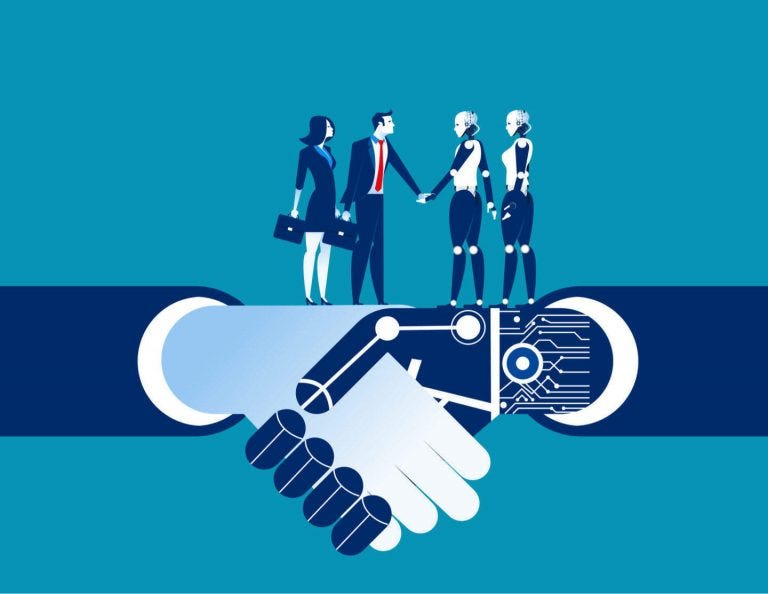
AI, Robotics and Cognitive Technologies powered by the superfast speeds of 5G will be at the core of the automation and work disruptions that will shape the fourth industrial revolution. As businesses move to adopt these new technological advancements in carrying out repetitive tasks to ramp up production, increase efficiency and reduce cost, jobs are being redesigned and work redefined. With machines handling routine and repetitive tasks, human labour is now required to do more skilled tasks that will require application of higher levels of human skills and capabilities like, problem solving, data analysis and interpretation, creativity, communications, customer service, teamwork and collaboration. When humans work with machines, data and algorithms (a process or set of rules to be followed in calculations or other problem-solving operations), there is significant gains in productivity and efficiency.
We will witness a change in how work is being done as we move towards task based systems. This will lead to a rise in remote workers or work-from-home (WFH) workforce as it is now fondly called. More companies will engage people on contract bases to perform specific tasks or execute particular projects as opposed to employing them as permanent staff and incurring all the overhead cost that is involved in retaining workers.
Perhaps one major industry that has been quite visibly impacted by automation is banking. As banks started to roll out automatic teller machines (ATM), we saw a decrease in bank teller staff. Most of these staff were laid off while others were moved to other departments even as the banks built more branches to get closer to the customers. With massive deployment of mobile applications by banks and development of different online payment solutions, the idea of brick and mortar banking is becoming archaic as physical bank visits have become largely unpopular. I really can’t remember when last I had to go run any transaction in a banking hall and I believe that is consistent with most of us.
As we transition into this new era of work, the World Economic Forum (WEF) has said in its Future of Jobs Report that a third of the skills we consider as crucial for today’s work would have changed in 5 years. These changes make it imperative for us to rejig and rethink what we teach students and how we train the existing workforce to take more challenging roles and equip students with skills that will prepare them to fit into the rapidly changing work environment. To succeed in the future workplace, one must stay committed to lifelong learning by possessing the ability to learn new things, collaborate, communicate, have good presentation skills and adapt to changing environments. Young people need to empower themselves with the following skills before entering the workforce:
- Understand how computers work.
- Know how to navigate the internet.
- Know how to use productivity tools.
- Know how to keep their computers safe.
While these new technologies will impact on virtually all spectrum of human endeavour, it will most rapidly affect fields like, manufacturing, construction, transportation, energy, agriculture, healthcare and education. As the Indian educationist, Harry Krishna Arya put it, “Teachers will not be replaced by technology, but teachers who do not use technology will be replaced by those who do.” Simply put, new jobs and opportunities for economic growth will accrue to those that embrace the technology, not those that resist it.
Brace Up! Skill Up!! And most importantly, Stay Safe!!!
Monday, 6 April 2020
5G; A Casualty of COVID-19 Misinformation.
 |
| 5G Cell Tower | Getty Images |
Like the
coronavirus, misinformation is a pathogen that has been spreading like wildfire.
It is razing the common sense of the masses and depleting the
intellectual capacities of the hitherto cerebral minds we once revered. This
current wave of misinformation has brought with it a tsunami of conspiracy
theories around the supposed ‘true cause’ of the coronavirus pandemic that has
brought the whole world to a standstill.
One of such theories that spread rapidly over the weekend, is one that linked the COVID-19 outbreak to the rollout of 5G network technology in Wuhan China. According to these malicious stories, the virus was released as a diversionary measure to distract the world, whilst national governments rollout the ‘deadly’ 5G network technology across the world. Some claimed that the pandemic is an attempt to conceal the truth about the ‘real killer’, which is 5G.
Further pushing this narrative is a cleric who despite identifying as a “tech enthusiast”, went on to assert that, both the coronavirus pandemic and the 5G rollout draped in the endearing features and possibilities of the Internet of Things (IOT) are all part of the grand scheme of world powers to administer vaccines to millions of people across the globe. The vaccine, “ID2020” as he tagged it, will usher in the New World Order (NWO).
These narratives which UK authorities have described as “dangerous nonsense”, are not only unfounded and the figments of the blurred imaginations of those propagating them, who irrespective of all the scientific explanations and empirical evidence that exist to rebuff these claims, have decided to stick to the concoctions of sceptics who are opposed to change and are out to stoke confusion and panic with unsubstantiated urban myths that are largely unsupported by any known scientific research or study in the midst of this ravaging pandemic.
As humans we are always scared of learning new ways of life and ditching ways and systems that we’ve found to be just efficient and have long standing attachments to. In such times we let these emotional attachments cloud our sense of judgement. There are lots of examples to show we have always had this scepticism about new things. I can remember that the single reason my mum refused to get a washing machine, was simply because she was of the view that it would make us all lazy. We all know that on person or persons who have refused to upgrade to newer versions of software because they believe that the ones they learnt with remains the best version. You will hear things like, “AutoCAD 2007 remains undefeated! Carry your 2020 version and go jare.” LOL! What they don’t know is that, developers are always iterating to come up with new features that will make the software more efficient and increase productivity.
Across all ages, there has been apathy for new ways of life, or fear of the unknown if you may. These worries are valid and quite understandable. People will be opposed to any change until its practical value becomes clear, especially when they are comfortable with what is existing and has been working for them. Like Steve Jobs said, “People don’t know what they want until you show it to them. Our job is to figure out what they are going to want before they do.” Henry Ford also said, “If I had asked customers what they wanted, they would have told me, ‘A faster horse!’”
As with previous generations of mobile connectivity, there’s been genuine safety concerns about how the radiofrequency radiation (RFR) emitted from all our connected devices are exposing us to health risks. From Physics we understand that anything emitted in the electromagnetic spectrum is of RFR. Microwaves, x-rays, radio waves, light from our devices and light from the sun are all examples. What makes any RFR dangerous is whether it falls into ionizing or non-ionizing radiation. It is true that the 5G wireless network works at a much higher frequency (between 24 to 90 gigahertz) than its predecessors. But our cell networks, as with FM radio waves, infrared, ultraviolet and visible light, are all of low frequency and fall under non-ionizing radiation, which makes them too weak to break chemical bonds or damage tissues.
Sceptics of the 5G rollout must be reminded that the amount of electromagnetic radiation they get exposed to from the sun is of greater magnitude than 5G networks will emit. There are lots of technology that are part of our daily lives that pose significantly higher risk. Statistics show that about 1.35 million people are killed in car crashes every year. This means that on the average, nearly 3700 die each day in road crashes. Also not forgetting the high level CO2 emissions from cars that is having serious impact on our environment and climate. These damning statistics and other human and environmental safety concerns notwithstanding, there has been massive adoption and widespread use of automobiles and other means of transportation as means of easing movement of people and goods to give more meaning to human existence.
Some of the notable peddlers of these misinformation, are themselves, guilty of contributing more CO2 than the average car user, as they travel in convoys of not less than 3 cars and fly in private jets. They must also not forget that the technology, whose capabilities they are relying on to reach millions of people across the globe, in propagating these falsehoods, spurred by the scepticisms of their technophobia are all early versions of the technology they are now strongly opposed to.
SO WHY 5G, IS 4G NOT ENOUGH?
Quite frankly 4G has been great so far, empowering us with network speeds that has enabled us share videos and make seamless video calls, go live on social media, watch videos on demand, or as we all like to put it; “Netflix and Chill” and even more importantly move around with ride sharing services like Uber and Bolt. But since time immemorial, there has always been this instinctive desire in man for advancement. It is even said that the only thing constant in life is change. Man has always sought out better ways to do things.
Two years ago, while watching my favourite CNN TV show, Quest Means Business, that I saw a CNN Money video explaining the 5G Network, that I got to understand the technology and why it’s very important as the backbone for the future.
5G is out to enable us attain network speeds and efficiency like we haven’t experienced before. To put this into perspective; today it will take you about 6 minutes to download a 3D movie on a great 4G network, with 5G it will take you only about 30 seconds to download same movie, as 5G has between 20 – 100% (depending on whether the network is utilizing the low or high-band spectrum) increase in download speeds compared to 4G LTE.
Although 4G already has low latency (lag time; the time between when devices communicate with each other or with the server), it is said that with 5G, latency is virtually zero. This is very important for next generation technologies like self-driving cars and other autonomous vehicles, which will require instantaneous communication between them and computers in the cloud, that will tell them how to respond to traffic situations around them, to ensure safety of the passengers and the autonomous vehicles themselves. Smart homes, smart cities, artificial intelligence (AI) powered robots and factories, are all things that will greatly rely on the rollout of the 5G technology to attain high levels of efficiency.
While we appreciate the efforts and dedication of these innovators and inventors in constantly seeking out ways to improve how we do things, I strongly believe that the onus is also on them to ensure massive education and enlightenment of the consumers on the need and changes the new generation network technology would bring before deployment, to act as a prophylactic that will mitigate the spread of misinformation and falsehoods, and prevent panic and apprehension at the alarming rate we are experiencing today.
Tuesday, 31 March 2020
COVID-19; The 21st Century Pandemic Forcing Us All To Stay Home And Do As Little As Wash Our Hands.

Engineer: (Walks into the container office) Gozie, have you heard the latest?
Me: No sir, tell me.
Engineer: Ah! Trump has approved Chloroquine for the
treatment of Covid-19. (basking in euphoria of hope.)
Me: (wondering when it became Trump’s duty to
approve drugs, I shrugged and said) Oh really? Must be nice.
Engineer: Yes oh! As we speak I’ve asked my wife to go
and stock up on chloroquine. She has also bought facemasks, clinical hand
gloves, vitamin C and other natural supplements.
Me: Wow! Safe to say you’re fully ready if this
becomes an outbreak in Nigeria.
Engineer: Yes oh! We have to stay woke.
Me: Yeah! In all, just try to stay alive.
In
recent weeks, the whole world has been grappling with the outbreak of the novel
coronavirus, which started in Wuhan China last year and has since spread to
over 170 countries, prompting the World Health Organization to declare it a
global pandemic on the 11th of March, 2020.
When
the virus was still domiciled in China, a lot of people and indeed world
leaders didn’t take the outbreak seriously. President Trump even called it a “Hoax”,
a word which he had also used to describe climate change, a phenomenon which a
lot of scientist from all over the world have been working on for decades.
Across
the globe, schools are shut, religious and social gatherings with large crowds
are being banned, sports and musical concerts are getting suspended, postponed
and in some cases cancelled altogether. The pandemic has forced us to adapt and
adopt new ways of life. Kids are now being home schooled, with a lot of people working
from home, and business meetings are now being held online over video conference
calls. Thankfully we’ve had the underlying technology tools and platforms to
backup these ways of life we’re now being forced to adopt while staying at
home.
Just
3 weeks ago, the world was puzzled as to why Africa seemed to have little to no
COVID-19 cases reported. A continent known for its poor healthcare systems,
which leaves its people largely vulnerable to all sorts of sicknesses and diseases,
all of a sudden, appeared to have been immune to a virus that has ravaged
leading economies in Asia, Europe and America and has stretched their
healthcare services beyond capacity.
According
to Africa Centre for Disease Control (Africa CDC) data, as of today, there are
over 4,700 confirmed COVID-19 cases, 146 deaths and 335 recoveries in 46
countries in Africa. South Africa is leading the pack with over 1,200 cases, 2
deaths, and 31 recoveries. Nigeria has 131 confirmed cases, 2 deaths and 3
recoveries. Africa is indeed, not immune to the virus and is faced with a
serious healthcare crisis with far damning consequences if urgent and drastic
measures are not taken to contain and curb the spread of this deadly virus that
is ravaging mankind and threatening human existence.
Faced
with the possibility of a potential outbreak, Federal and State governments
have resorted to imposing extreme prevention and containment measures like,
shutting down airports and closing all land and sea borders, preventing people
from going in or out the states. Our government, by reason of those draconian
measures, think they are ahead of the curve, but quite frankly, they are not. Being
ahead of the curve would mean having good health care systems in place, with
motivated healthcare personnel and adequate medical supplies to handle a
possible outbreak whilst hoping that scientists and pharmaceutical companies
can develop antiviral treatments and ultimately a vaccine before long.
As
nations with seemingly good healthcare systems around the world are getting
overwhelmed by the astronomical rise in the number of new cases daily, and are
running out of much needed medical equipment and supplies with factories and
borders shutdown, there are fears of a looming global economic meltdown as more
countries are faced with possible economic recession. More so, there is
widespread anxiety that if these lock downs are allowed to persist for a long
time with no government support in terms of food and other essential supplies,
a lot more people may suffer from hunger than the virus itself.
The lock downs will avail us with enough time for retrospection and realignment of
priorities. For decades our political
class have sought medical care abroad, sometimes utilizing public funds while
neglecting the nations healthcare system, leaving many hospitals in ruins. With
the current reality of nations shutting their borders to foreigners, our elites
have been left with no choice than to seek help in the hospitals and medical
facilities they refused to equip and build. Hopefully at the end of this all,
we will learn to look within and fix our country’s healthcare system, which is
lying in a critical state and in dire need of life support. At the end of the
day, we have nowhere else to call home.
With
misinformation spreading even faster than the virus itself, more people have
been exposed to falsehoods about coronavirus, than there are people infected
with the virus. As The New Yorker
Magazine Editor, David Remnick put it; “Misinformation
is a pathogen. It can cost lives.” With so much yet to be known about the
new virus and no confirmed cure yet, it’s easy to fall victim of misinformation.
As epidemiologists and other public health scientist and leaders around the
world are trying to answer those questions and come up with policies to curb
the spread of this virus, I would implore everyone to stay calm as a lot of
people are actually recovering daily. Let us make responsibility go viral this
period by listening to the authorities and staying home, washing our hands
regularly, keeping our social distance and practicing respiratory hygiene.
Together
we can stop the virus. Stay Home! Stay Safe!! Save Lives!!!
Subscribe to:
Comments (Atom)